
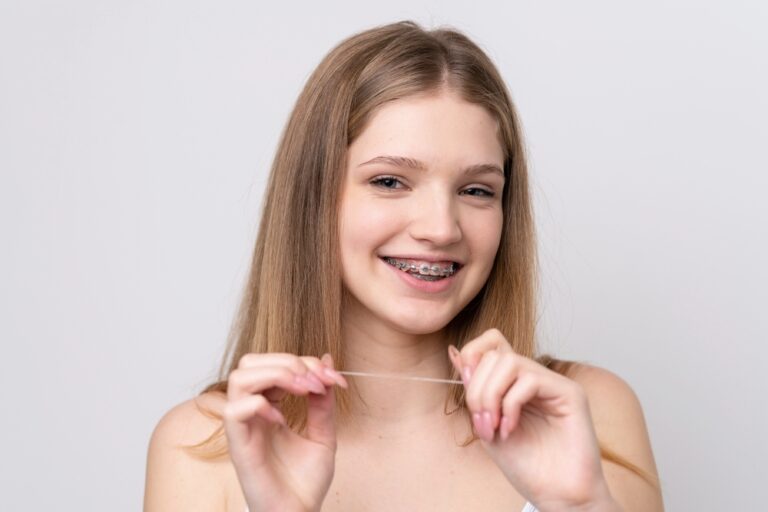
The right tools matter, but technique and consistency matter more. A step-by-step guide from Dr. Jacob at Smile City Orthodontics, Sunnyvale, TX.
How to clean braces properly starts with understanding that braces do not cause cavities on their own, but they create dozens of new surfaces for plaque and food to collect where a regular toothbrush cannot reach. Patients who clean well throughout treatment finish with healthy enamel. Patients who clean poorly can develop white spots, early decay, or gum problems that outlast the braces themselves. The combination that works is an orthodontic toothbrush used at the right angle, a method for getting floss under the archwire, and a fluoride rinse at the end of the day. Doing all three consistently is more important than which specific products are used.
Most patients who get braces focus on the end result: straight teeth, a confident smile. What keeps that result looking the way it should is what happens twice a day for the next 18 to 24 months while the brackets are on.
At Smile City Orthodontics in Sunnyvale, Dr. Jacob reviews cleaning technique with every patient at the bonding appointment, using digital imaging to show exactly where plaque tends to accumulate around brackets before it becomes a problem.
The guide below covers the same ground: why cleaning is harder with braces, which tools do the job, the technique that reaches every surface, and the daily routine that makes it manageable rather than exhausting.

Why Cleaning Braces Is Harder Than It Looks
A tooth without braces has a smooth, curved surface that a toothbrush can sweep relatively efficiently. A tooth with a bracket has four additional edges around the bracket itself, a narrow channel between the bracket and the gumline, spaces under and beside the archwire, and the contact points between brackets where the wire connects. Every one of those spaces traps food and allows plaque to form undisturbed if the brush does not reach it.
The biological risk is real. Plaque that sits against the enamel for extended periods produces acid that demineralizes the tooth surface. Around brackets, this shows up as white spot lesions: chalky, dull patches that appear when the brackets come off and the enamel underneath has been weakened. White spots are permanent. They can be managed cosmetically but they cannot be reversed, which is why prevention during treatment matters far more than any repair afterward.
Gum health is the other side of the same problem. Plaque that builds up along the gumline causes inflammation, swelling, and in chronic cases recession and bone loss. Swollen gums around brackets are not just uncomfortable; they make adjustments harder and, if they persist, can affect the result. Good cleaning is not optional hygiene advice. It is a clinical requirement for the treatment working as planned.
The Two Things That Determine Whether Cleaning Works
Patients who struggle with braces hygiene almost always have a problem in one of two areas, not both.
The first is tools. Using a standard flat toothbrush on braces, without any floss or interproximal brush to reach under the wire, leaves significant areas uncleaned regardless of how long or carefully the brushing happens. The brush geometry simply cannot reach certain surfaces. Buying one or two additional tools solves this.
The second is angle and pressure. Many patients brush past the brackets rather than into them, moving the brush across the front face of the brackets in broad strokes that feel thorough but miss the margins where plaque actually accumulates. The technique section below addresses this specifically.
Both problems are fixable with a short demonstration. Dr. Jacob reviews cleaning technique with every patient at the bonding appointment so that the right habit is established from day one rather than corrected at a six-week check when early plaque signs are already visible.
The Tools Worth Having
You do not need a large collection of products. You need a small set of tools that each cover a surface the others cannot reach.
An orthodontic toothbrush or soft-bristle brush with a compact head. Some patients prefer a brush specifically designed for braces (often with a V-shaped bristle trim that brackets fit into); others do well with any soft-bristle brush with a compact head that can maneuver around individual brackets. Either works. What matters is that the bristles are soft enough not to damage the enamel or gum tissue and that the head is small enough to work around each bracket individually.
An electric toothbrush is a practical upgrade for patients who struggle with manual brushing. The oscillating or sonic motion does some of the work passively, and many electric brush heads are designed to reach the bracket margins well. The same angle and coverage rules apply regardless of whether the brush is manual or powered.
A floss threader, orthodontic floss (Superfloss), or a water flosser. All three serve the same purpose: getting cleaning action under the archwire and between teeth. A floss threader works with regular floss and takes some practice but adds no cost. Superfloss has a stiffened end that threads under the wire more easily and a spongy section that cleans the bracket contact area. A water flosser uses a pulsing stream of water and is the fastest method once the habit is established. Any of the three is far better than skipping interproximal cleaning entirely.
Interdental (proxy) brushes. These small cone- or cylinder-shaped brushes fit under the archwire and clean the space between the wire and the tooth surface, an area a toothbrush typically cannot reach. They are particularly useful for patients with larger spaces between brackets, and for clearing food that gets packed in around the wire after meals.
A fluoride toothpaste and fluoride mouthwash. Fluoride actively strengthens enamel and reduces the risk of white spot formation under and around brackets. Using a fluoride toothpaste for brushing and a fluoride rinse as the last step before bed adds a protective layer that mechanical cleaning alone does not provide. Alcohol-free rinse formulas are preferable since they are gentler on the soft tissue around brackets.
Step-by-Step Brushing Technique
The goal is not speed. It is making sure every surface around every bracket gets covered in the two to three minutes a session takes.
Step 1: Rinse first. A quick water rinse before brushing loosens surface food and makes it easier to see what you are working with.
Step 2: Angle the brush at 45 degrees toward the gumline. Start at the gumline, not at the bracket. Short circular or vibrating strokes at a 45-degree angle to the tooth surface clean the gum margin where plaque most commonly causes early inflammation. Work across the entire arch before moving to the next step.
Step 3: Brush above the bracket. Angle the brush so the bristles press slightly under the top edge of each bracket. The gap between the bracket’s upper edge and the tooth above it accumulates plaque that a flat brushing motion never reaches. Work along the arch tooth by tooth.
Step 4: Brush below the bracket. Same approach at the lower edge of each bracket. Angle the bristles into the space between the bracket’s lower edge and the gumline below it.
Step 5: Brush the front face of the brackets. This is the area most patients only clean. It is also the least important surface for decay prevention, though it matters for keeping the brackets visible and clean. Gentle circular strokes across the front faces of the brackets finishes this pass.
Step 6: Clean the chewing surfaces and the backs of the teeth. Standard brushing technique for these surfaces. The bracket hardware does not extend to the back surfaces or the biting surfaces of the molars, so these areas respond to normal brushing once the front and sides are covered.
Step 7: Spit, do not rinse. Leaving the fluoride toothpaste residue on the teeth for a few minutes before rinsing maximizes the fluoride contact time with the enamel.
How to Floss With Braces
This is the step most patients skip because it is genuinely more difficult with braces than without. The wire blocks the path floss normally takes between teeth, so threading it through takes extra effort. Once the technique is routine, it adds about two to three minutes to the cleaning session.
Floss threader method. Thread a length of regular floss through the loop of the threader. Use the stiffened end of the threader to guide the floss under the archwire between two teeth. Once through, hold both ends of the floss and slide it up and down the side of each adjacent tooth to the gumline, then pull it out and rethread for the next space. This works with any standard floss and is low cost.
Superfloss method. Superfloss has a stiffened tip built in, so no separate threader is needed. The stiffened end threads under the wire; the spongy middle section cleans the bracket contact area; and the regular floss section cleans the normal interproximal surfaces. It is faster than the threader for many patients.
Water flosser method. Fill the reservoir, set the pressure to a comfortable level (low is a good starting point for new users around brackets), and direct the stream between each pair of teeth and along the gumline. It is the fastest method once the habit is established. It does not fully replace mechanical flossing for all patients, but for most braces patients it is an effective and sustainable option when consistent flossing with a threader has failed.
The best method is whichever one actually gets done every day.
A Practical Daily Routine
Follow this simple routine to keep your teeth and braces clean throughout the day.
| Time | What to do | Why it matters |
| Morning | Brush with orthodontic toothbrush, 2 minutes; use proxy brush under wire | Clears overnight plaque accumulation before eating |
| After every meal or snack | Quick brush or at minimum a water rinse; use proxy brush if food is trapped | Food left against brackets is what allows plaque to form; removing it quickly breaks the cycle |
| Before bed | Brush for 2 minutes (full technique); floss under the wire with threader, Superfloss, or water flosser; fluoride rinse as the last step | Night is when saliva flow is lowest and the teeth are most vulnerable; the fluoride rinse provides protection through overnight hours |
Two full cleaning sessions per day is the minimum. After meals and snacks, a quick brush or rinse reduces the window during which food sits against the brackets, which is when most of the acid exposure happens. The bedtime session is the most important and should always be the most thorough.
What Happens When Cleaning Falls Short
Being direct about this is more useful than avoiding it.
White spot lesions are the most common consequence of poor braces hygiene. They appear as chalky white patches on the enamel surface, usually at the margins of where the brackets sat. They are caused by acid demineralization and are visible immediately when the brackets come off. They are permanent, though treatments like microabrasion or fluoride varnish can partially improve their appearance. Prevention during treatment is the only reliable approach.
Cavities around brackets develop for the same reason: acid from plaque sitting against the enamel in areas the brush did not reach. Cavities during orthodontic treatment can complicate the treatment plan and in some cases require the bracket to be removed, the tooth treated, and the bracket rebonded, adding time to the overall timeline.
Gum inflammation and overgrowth around brackets is a sign that plaque along the gumline is not being cleared. Mild gingivitis during braces is common and resolves when cleaning improves. Persistent inflammation that is not addressed can progress to early periodontitis and in some cases cause the gum tissue to grow up and around the bracket, which interferes with tooth movement and requires trimming before treatment can continue.
Foods That Work Against Your Cleaning Routine
This is not a complete food restriction list but rather the specific categories that cause the most cleaning problems rather than just the most mechanical risk to brackets.
Sticky or chewy foods leave residue packed around brackets and under wires that does not come out with a simple rinse. Caramel, gummy candies, dried fruit, and chewy granola bars are the most common culprits and are worth avoiding for the duration of treatment.
Sugary drinks, including juice and sports drinks, coat every surface of the mouth with sugar that feeds the acid-producing bacteria responsible for white spots. Water is the safe choice. If sugary or acidic drinks are consumed, rinsing with water immediately after reduces the exposure window.
Hard foods that require biting with the front teeth risk bracket damage, which creates gaps and rough surfaces where plaque collects. Corn on the cob, whole apples, and crusty bread are the most common examples. Cutting them into smaller pieces before eating keeps the brackets intact.
How Smile City Orthodontics Supports Patients Through Treatment
Every new braces patient at Smile City Orthodontics receives a cleaning demonstration at the bonding appointment, covering the correct brush angle, technique around brackets, and which interproximal tools are recommended for that patient’s specific arch spacing and treatment plan. Dr. Jacob reviews hygiene progress at every adjustment visit and addresses early plaque or gum signs before they become a larger problem.
The practice uses digital scanning technology at each visit, which provides enough resolution to monitor enamel and gum condition alongside tooth movement. If a patient’s hygiene is falling behind, the conversation happens early enough to course-correct rather than at debond when the damage is already done.
Same-day appointments are available for bracket repairs, and the team can walk through cleaning technique in person if a patient has questions between scheduled visits.
Serving Sunnyvale Braces Patients Across the Area
Smile City Orthodontics is located at 180 S Collins Rd, Suite 200, Sunnyvale, TX and sees braces patients from the surrounding communities, including Mesquite, Garland, Rowlett, Rockwall, Wylie, and Murphy. The office is just off Highway 80, approximately 20 minutes from Downtown Dallas and 15 minutes east of Garland.
The cleaning routine described in this guide applies to every braces patient regardless of location. Metal brackets and ceramic brackets work through the same mechanics and present the same cleaning challenges. The specific tools and technique are what change the outcome, and both are things Dr. Jacob and the team go over with every patient at the start of treatment.
Common Questions About Cleaning Braces
How many times a day should I brush with braces?
At minimum twice a day, with a full technique session in the morning and before bed. Ideally, a quick brush or at least a water rinse after every meal and snack reduces how long food sits against the brackets. The bedtime session is the most important and should always be the most thorough, since saliva flow decreases overnight and the teeth have less natural protection during those hours.
Is a water flosser enough, or do I still need regular floss?
For most braces patients, a water flosser used consistently is effective at reducing interproximal plaque and is a sustainable daily habit. It is not identical to mechanical flossing in the force it applies to the tooth surface, but in practice, a water flosser used every day outperforms traditional flossing that gets skipped because it is too time-consuming. The best option is whichever one you will actually do.
What are white spots, and can they be fixed?
White spot lesions are areas of enamel demineralization that appear as chalky, dull patches, usually visible at the bracket margins after the braces come off. They are caused by acid from plaque sitting against the enamel for extended periods. They are permanent changes to the enamel surface. Treatments like microabrasion, fluoride varnish, or resin infiltration can improve their appearance to varying degrees, but they cannot fully restore the enamel to its original condition. Prevention during treatment is the most reliable approach.
Do electric toothbrushes work better than manual for braces?
For many patients, yes, particularly those who find it hard to maintain the correct manual brush angle consistently. The oscillating or sonic motion of an electric brush does some of the mechanical work passively and tends to clean bracket margins more consistently. The same principles apply regardless: the brush still needs to be angled toward the gumline and into the bracket margins rather than just swept across the front face of the brackets.
My gums bleed when I floss around my braces. Should I stop?
Bleeding gums when flossing is usually a sign of early gingivitis, meaning the gum tissue is inflamed from plaque accumulation at the gumline. Stopping flossing because of the bleeding is the opposite of what helps. Consistent daily flossing reduces the inflammation and the bleeding typically decreases within a week or two as the gums become healthier. If the bleeding is heavy, persistent, or accompanied by significant swelling or pain, mention it at the next appointment so Dr. Jacob can assess whether it needs attention.
Sources. General clinical literature on enamel demineralization and white spot lesion formation during orthodontic treatment, plaque management around fixed appliances, and fluoride application during braces, described qualitatively. Appliance-specific details and practice hygiene protocols from Smile City Orthodontics, Sunnyvale, TX.

Related Reading
- Braces in Sunnyvale, TX
- Metal Braces at Smile City Orthodontics
- Clear Braces at Smile City Orthodontics
- Teeth Retainer in Sunnyvale, TX
- Invisalign in Sunnyvale, TX
Get Your Braces Started with a Free Consultation in Sunnyvale
Smile City Orthodontics offers free orthodontic consultations in Sunnyvale, TX. Dr. Jacob uses 3D digital scanning and CBCT imaging to build a personalized treatment plan, with same-day starts available and flexible 0% APR financing.
Schedule Your Free Consultation