
Reviewed by Dr. George Jeryn Jacob, BDS, MDS, MS, Diplomate of the American Board of Orthodontics and member of the American Association of Orthodontists.
This article is for educational and informational purposes only and is not a substitute for professional medical advice, diagnosis, or treatment. Cost figures are third-party national estimates, not Smile City Orthodontics prices, and your cost depends on your case and your plan.
Short answer: Ceramic braces use tooth-colored brackets that blend in more than metal ones, and they often cost more. Metal braces are more noticeable but durable, and they are often the lower-cost option. Neither is better for everyone. The right choice depends on your case, your budget and how much appearance matters to you.
Talk with Dr. Jacob about which braces fit your case and budget, or call (214) 663-9144.
If you are comparing braces in Sunnyvale, Mesquite, Forney, and neighboring communities, you have probably seen two options: metal braces and ceramic braces. Both straighten teeth. They differ in how they look, what they cost, and how they hold up day to day. This guide compares them side by side, shows what national cost estimates say, and lists the questions to ask before you decide.
What Are Ceramic Braces and How Are They Different From Metal Braces?
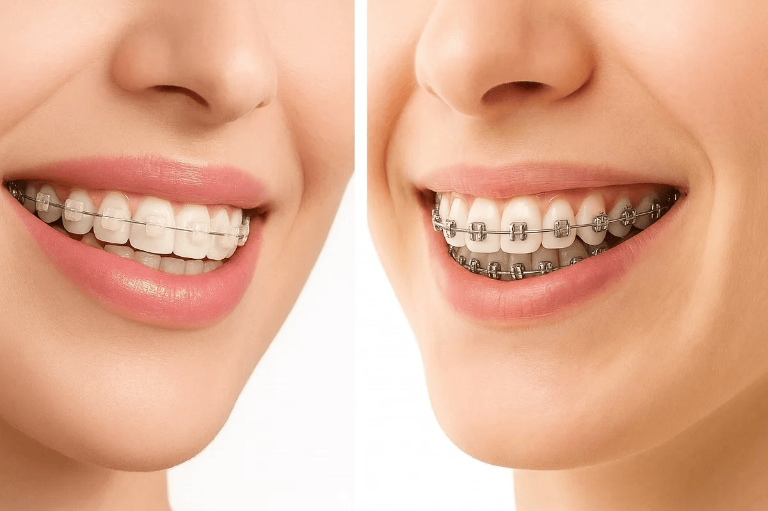
Ceramic braces are fixed braces with clear or tooth-colored brackets. Metal braces use stainless steel brackets. Both use brackets and wires to move teeth with gentle, steady pressure, and neither can be removed at home. The main differences are how visible they are, how they hold up, and what they cost.
Both types work the same way. A bracket is bonded to each tooth, a wire connects them, and your orthodontist adjusts the wire over time. The American Association of Orthodontists (AAO) describes ceramic braces as using “clear or tooth-colored brackets instead of metal brackets.” Depending on your treatment plan, the wires or elastic ties may be tooth-colored too.
In this article: Ceramic braces are fixed braces with clear or tooth-colored brackets. Metal braces are fixed braces with stainless steel brackets. Our website lists the ceramic option as clear braces. We use “ceramic braces” throughout this article.
Smile City Orthodontics offers both options, along with Invisalign. Learn more on our pages for clear (ceramic) braces and metal braces, or read our ceramic braces FAQ for what to expect with this type.
Ceramic Braces vs. Metal Braces at a Glance
Ceramic braces are less noticeable and may cost more. Metal braces are easier to see and are often the lower-cost option. Comfort varies from person to person with either type. Ceramic brackets may be more brittle, and their elastic ties can discolor. Treatment time depends mostly on your case, not the bracket.
| Ceramic braces | Metal braces | |
| Appearance | Clear or tooth-colored brackets blend in with your teeth | Stainless steel brackets are more visible |
| Typical cost | Often higher, though ranges overlap with metal (see the cost section) | Often lower, and generally the more budget-friendly option |
| Comfort | Varies from person to person | Varies from person to person. Soreness after adjustments is normal |
| Staining | Brackets resist staining, but clear or white elastic ties can discolor | Brackets are not tooth-colored, so discoloration is less visible |
| Durability | May be more brittle than metal | Durable. May be recommended when a very durable appliance is needed |
| Treatment time | Depends on your case. Most people are in braces one to three years | Depends on your case. Most people are in braces one to three years |
| Often a good fit for | Adults, older teens and anyone self-conscious about metal. Not right for every case | People who want a durable option, often at a lower cost |
Sources: AAO, American Dental Association (ADA), and Smile City Orthodontics’ braces cost page. Your orthodontist makes the final recommendation after examining you.
How Much Do Ceramic and Metal Braces Cost?
Brace costs vary by case, location, and practice. One national estimate puts metal braces at $2,750 to $6,000 and ceramic braces at $3,000 to $7,000 without insurance. Ceramic often costs more, but the ranges overlap. Only an exam can give you your own price.
What national estimates show
| Braces type | Estimated cost without insurance | Notes |
| Metal braces | $2,750 to $6,000 | Third-party national estimate |
| Ceramic braces | $3,000 to $7,000 | Third-party national estimate |
Source: ValuePenguin’s national braces cost estimate (updated September 2026). ValuePenguin also lists a $5,991 national average for braces overall, which it attributes to the ADA.
These are not Smile City Orthodontics prices. They are national estimates from a third party, and other published guides give different ranges. That is a good reason to treat any single number with care. If you have seen a $7,000 quote and wonder whether it is a lot, note that it sits at the top of both ranges above. Ask what a quote includes, such as follow-up visits and retainers, before you compare offices. The AAO notes that some orthodontists offer all-inclusive pricing.
Why ceramic braces can cost more
The AAO says ceramic braces “may cost more than traditional metal braces in some cases because of the materials used.” Our braces cost page also lists metal braces as generally more budget-friendly than clear braces or Invisalign. Your price depends on more than the bracket: treatment complexity, treatment length, your age and the practice all play a role.
Insurance, HSA/FSA and payment plans
The AAO says dental insurance may include orthodontic benefits, but coverage “can vary significantly between policies.” Plans often pay a percentage of the cost or a fixed benefit amount. Ask your plan two things: whether orthodontics is covered for your age, and whether it pays the same benefit for ceramic and metal braces. Some plans base their payment on the least costly acceptable option, which can leave a balance if you choose a higher-cost type.
Smile City Orthodontics verifies your insurance for free and files claims for you. See our orthodontic insurance page for the plans we work with. We also offer no-interest braces payment plans and can help you use HSA or FSA funds. Your free consultation is where you will get a cost estimate for your own treatment.
Talk with Dr. Jacob about which braces fit your case and budget, or call (214) 663-9144.
Which Is More Comfortable: Ceramic or Metal Braces?
Comfort varies from person to person with both types. The AAO says patients may notice differences in how brackets feel, and the ADA says today’s braces are more comfortable than ever before. Soreness after an adjustment is normal and temporary with either type, and over-the-counter pain relievers can help.
No type is always more comfortable. How your braces feel depends on your teeth, your bite and how sensitive you are. If irritation from brackets bothers your cheeks or lips, tell your orthodontist. There are usually ways to ease it.
Do Ceramic Braces Stain or Break More Easily?
Do ceramic braces stain?
Ceramic brackets resist staining, but the clear or white elastic ties that hold the wires can discolor over time. Brushing and flossing as directed keeps your braces cleaner, and your orthodontist can explain which foods and drinks to limit. Ask which parts of your braces are most likely to change color.
Our ceramic braces FAQ explains this same point: the brackets resist staining, while the ties can discolor. Ask your orthodontist how often the ties are replaced.
Are ceramic braces more fragile than metal?
Ceramic brackets can be effective, but the AAO says the material “may be more brittle than metal.” That is why metal braces may be recommended when a very durable appliance is needed. A broken bracket needs a repair visit, so ask your orthodontist how breakage is handled and what to avoid eating.
Following your orthodontist’s instructions on food, cleaning and protecting your braces is the best way to lower the chance of damage with either type.
Does Treatment Take Longer With Ceramic Braces?
Treatment time depends mainly on your case, how far your teeth need to move, and how closely you follow your plan. The ADA says most people are in treatment for one to three years. Ask your orthodontist whether the type of bracket changes your estimate.
The AAO lists “How long will my treatment take?” as a question to ask your orthodontist, and for good reason. No two plans are alike. Your estimate is set after an exam, and it can change as treatment moves forward. We do not promise a finish date before we have examined you.
Which Is Right for You: Ceramic or Metal Braces?
Ceramic braces may suit adults, older teens and anyone who feels self-conscious about metal. Metal braces may suit people who want a durable, often lower-cost option. The AAO says neither is automatically better for everyone, so your orthodontist decides with you after an exam.
Ceramic braces may be a good fit if you:
- want braces that are less noticeable
- are an adult or older teen who feels self-conscious about metal
- are comfortable with extra care for the elastic ties
- have room in your budget for a possibly higher cost
Metal braces may be a good fit if you:
- want a durable appliance
- want to keep cost lower
- care more about results and budget than about how braces look
The AAO also notes that ceramic braces are “not right for every patient or every orthodontic concern.” If you would prefer something removable, ask about Invisalign. Clear aligners suit some cases and not others. See our comparison of Invisalign vs. braces, or read our broader post on clear braces vs. metal braces in Sunnyvale.
Questions to Ask at Your Braces Consultation
A good consultation answers your cost and care questions, not just your treatment questions. Bring this list and ask for the answers in writing when you can. It helps you compare offices fairly and avoid surprises later, whichever type of braces you choose.
- Which type of braces do you recommend for my case, and why?
- Which ceramic bracket system do you use, and what do the wires and ties look like?
- What is my total cost, and what does it include (visits, retainers, repairs)?
- Is the price the same for ceramic and metal braces, or how much does it differ?
- What does my insurance cover, and will you verify it and file claims?
- What payment plans are available, and can I use HSA or FSA funds?
- How long do you estimate my treatment will take, and what could change that?
- What happens if a bracket breaks or a tie stains?
At Smile City Orthodontics, Dr. Jacob examines your teeth, discusses your goals and creates a treatment plan for you. The first visit is a free orthodontic consultation.
Frequently Asked Questions
Which is better, ceramic or metal braces?
Neither is better for everyone. Ceramic braces are less noticeable and may cost more. Metal braces are more visible and durable, and often cost less. The AAO says neither option is automatically better, so your orthodontist helps you choose based on your case, budget and goals.
Are ceramic braces more expensive than metal braces?
Often, but not always. The AAO says ceramic braces may cost more in some cases because of the materials. One national estimate lists metal at $2,750 to $6,000 and ceramic at $3,000 to $7,000, so the ranges overlap. Your own quote depends on your case.
Does insurance cover ceramic braces?
It depends on your plan. Some dental plans cover orthodontics as a percentage or a fixed amount, and others do not. Some pay based on the least costly option. Ask your plan about your age and bracket type, or ask our team to verify your benefits for free.
Do ceramic braces hurt more than metal braces?
Comfort varies from person to person. The AAO says some patients notice differences in how brackets feel. Soreness after adjustments is normal and temporary with either type, and over-the-counter pain relievers can help. Tell your orthodontist if brackets irritate your cheeks or lips.
Do ceramic braces stain?
The brackets resist staining, but clear or white elastic ties can discolor over time. Brushing and flossing as directed helps keep braces clean. Ask your orthodontist how often ties are replaced and which foods and drinks to limit during treatment.
Are ceramic braces more likely to break?
The AAO says ceramic material may be more brittle than metal, so a bracket may break more easily in some cases. Following food and care instructions helps with either type. Ask your orthodontist how breakage and repair visits are handled before you choose.
Can adults get ceramic braces?
Yes. The AAO says ceramic braces may be especially appealing to adults, older teens and anyone self-conscious about metal braces. They are not right for every case, so your orthodontist decides after an exam. See our page on adult orthodontics in Sunnyvale for more.
Does Smile City Orthodontics offer ceramic braces?
Yes. Smile City Orthodontics offers ceramic braces, which our site also calls clear braces, along with metal braces and Invisalign. Dr. Jacob examines your teeth, discusses your goals and recommends a plan. Book a free consultation to see which option fits your case and budget.
Book a Free Consultation at Smile City Orthodontics
Choosing between ceramic and metal braces is easier when you can see your own treatment plan and price. At your free consultation, Dr. Jacob will examine your teeth, explain your options and give you a cost estimate. Our team will also verify your insurance and review payment plans and HSA or FSA options with you.
Talk with Dr. Jacob about which braces fit your case and budget, or call (214) 663-9144.
Smile City Orthodontics is at 180 S Collins Rd, Suite 200, Sunnyvale, TX 75182. The office is open Monday through Friday, 8:00 am to 5:00 pm, and on the fourth Saturday of each month, 8:00 am to 1:00 pm, by appointment only. Call (214) 663-9144.